Why the box size is wrong for dosing
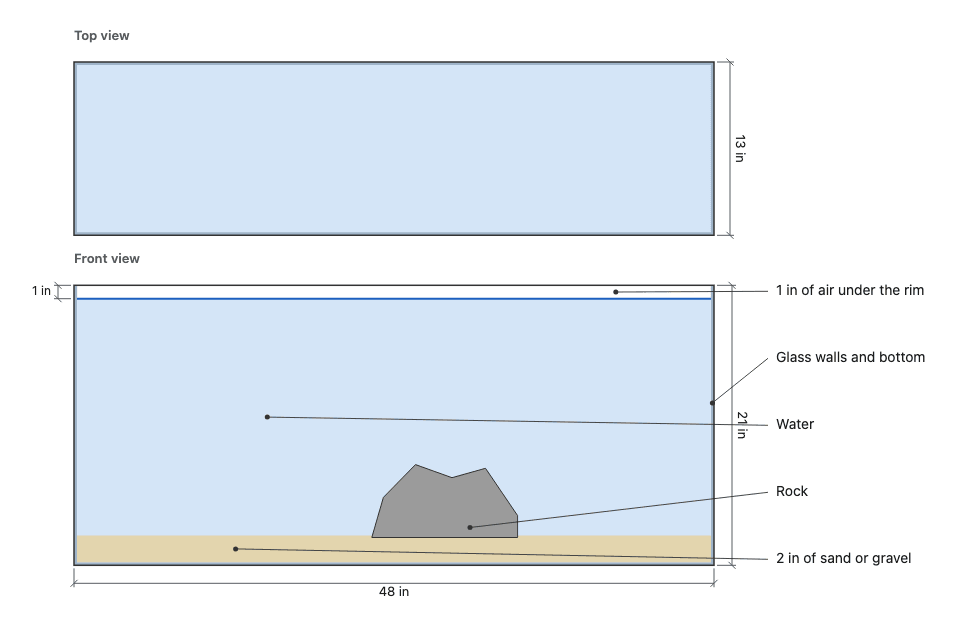
A 55 gallon tank measures 48 x 13 x 21 inches on the outside. Multiply and divide by 231 and you get 56.7 gallons. That is the number most calculators give you, and it is the volume of a solid block the size of your tank.
Fill it to an inch below the rim, put in 2 inches of sand and 30 pounds of rock, and the water drops to 46.5 gallons. Dose by the box number and every treatment runs about 22 percent strong.
Sand does not take its full depth. Water fills the gaps between grains, about 40 percent of the bed, so the calculator only counts the rest. Rock works the same way: porous stone soaks up water, and only the stone itself pushes water out.
Formulas for each tank shape
Measurements in inches give US gallons. In centimeters, swap 231 for 1,000 and you get liters. These are the outside volumes, before glass, sand and the gap.
| Shape | What to measure | US gallons |
|---|---|---|
| Rectangle or cube | Length L, depth D, height H | L × D × H ÷ 231 |
| Bow front | Length L, depth at the ends E, depth at the middle M, height H | (L × E + bow area) × H ÷ 231 |
| Cylinder | Diameter d, height H | 3.1416 × (d ÷ 2)² × H ÷ 231 |
| Hexagon | One panel width a, height H | 2.598 × a² × H ÷ 231 |
| Pentagon corner | Wall side S, short side panel P, height H | (S² − (S − P)² ÷ 2) × H ÷ 231 |
| Quarter circle corner | Wall side R, height H | 0.7854 × R² × H ÷ 231 |
What the numbers assume
- Water
- 8.34 lb per US gallon fresh, 8.55 lb salt (1 and 1.025 kg per liter).
- Glass
- 2.5 kg per liter. Acrylic is 1.19, under half as heavy.
- Sand and gravel
- 1.6 kg per liter as poured. Water fills about 40 percent of the bed.
- Rock
- 2.6 kg per liter of solid stone, which covers most limestone, slate and dragon stone.
- Heater
- 3 to 5 watts per gallon of real water. Two smaller heaters are safer than one big one.
- Filter
- 4 to 6 times the real volume per hour. Planted tanks and slow fish want the low end.
- Salt
- About 37 g of mix per liter for 1.025 specific gravity. Brands vary, so finish with a refractometer.
- Not counted
- Plastic frames, center braces, filter boxes inside the tank and wood. Wood floats until it soaks, then takes up about its own size.
Common tank sizes
Real water assumes an inch below the rim and 1.5 to 2 inches of sand. The full sizes chart has 15 tanks with weights.
| Tank | Outside, inches | Math, gal | Real water, gal |
|---|---|---|---|
| 10 gallon | 20 x 10 x 12 | 10.4 | 8.1 |
| 15 gallon | 24 x 12 x 12 | 15.0 | 11.7 |
| 20 gallon long | 30 x 12 x 12 | 18.7 | 14.7 |
| 40 gallon breeder | 36 x 18 x 16 | 44.9 | 36.6 |
| 55 gallon | 48 x 13 x 21 | 56.7 | 47.8 |
| 75 gallon | 48 x 18 x 21 | 78.5 | 65.8 |
Questions people ask
How do I work out my aquarium volume in gallons?
Measure length, depth and height in inches, multiply them, and divide by 231. A US gallon is 231 cubic inches. A 30 x 12 x 12 inch tank is 4,320 cubic inches, or 18.7 gallons. For UK gallons, divide by 277.4 instead.
How do I work out the volume in liters?
Measure in centimeters, multiply length by depth by height, and divide by 1,000. A 60 x 30 x 36 cm tank is 64,800 cubic centimeters, or 64.8 liters.
Why does my tank hold less water than its size?
The size comes from the outside measurements. Glass takes some of that space, you fill to below the rim, and sand and rock push water out. Together that is usually 10 to 20 percent of the box number.
Should I dose medication for the tank size or the real water?
The real water. Labels dose per gallon or liter of water, and using the box size gives the fish more than the label intends. Take out any carbon from the filter if the label says to, and follow the label over any calculator.
How much does a full fish tank weigh?
A rough rule is 10 pounds per gallon of tank size, counting water, glass and gravel. Freshwater weighs 8.34 lb per gallon on its own. The calculator adds the glass, sand and rock you enter for a closer number.
How many gallons is a 24x12x12 tank?
15.0 gallons from its outside measurements, and about 11.7 of real water. More on the 24 x 12 x 12 page.
How many gallons is a 48x13x21 tank?
56.7 gallons from its outside measurements. It is the standard 55 gallon and holds about 47.8 of real water. More on the 48 x 13 x 21 page.